

Recently, I've been rediscovering all of my favorite illustrators. Because of all the excitement this has brought me, I thought I would share twelve of my favorites. Maybe through you, I will discover more...
Here is my list, which is unfinished and unranked. Most of my information is un-cited, but you can trust me! Or not!

Tomi Ungerer
Tomi Ungerer was a writer and illustrator from Strasbourg, France. My personal favorite of his is the 1958 book Crictor, a tale about an old lady whose son sends her a snake in the mail. She and the snake soon become fast friends, and the story culminates with him saving her and her valuables from a cat burglar. He wrote 140 books throughout his career, and you can find many of the more popular ones either on Internet Archive or narrated on YouTube.

Good ones to check out:
Crictor
The Hat
The Beast of Monsieur Racine
The Mellops Go Flying
The Three Robbers
Adelaide
One of Ungerer's books, The Beast of Monsieur Racine, got turned into a short film by Gene Deitch.* This short is awesome! The story is about a man who grows delicious pears, and decides to trap the mysterious person stealing them... As it turns out, the thief is a never-before seen creature, and the two become great friends. Watch it here.
A few of his other stories have been turned into movies or shorts, but this is the best by far. The Hat is also good, (Deitch did this one too) but the Beast is better. Feel free to judge for yourself.

He also illustrated for other authors' books, one of them being the 1964 and '74 versions of Flat Stanley by Jeff Brown, another one of my favorites. One I discovered in my research for this post, is Mr. Tall and Mr. Small by Barbara Brenner. It is about a giraffe and a mouse arguing about whose size is better. Soon, they band together to escape a fire caused by a hunter's cigarette. What a great mouse Tomi Ungerer drew!
If you want to learn more, here is a youtube video that goes more in depth on his background over a slideshow of his art. You could also watch the documentary about him called Far Out Isn't Far Enough directed by Brad Bernstein.

*Deitch is incredible and a recently discovered favorite blogger of mine. You may know him from his work directing episodes of Tom and Jerry and Popeye. He was also the audio engineer for Connie Converse. He and Jules Feiffer (who is in this list too) made a wonderful short about a 4 year old getting drafted to the military called Munro. Watch it!!! Read more about him here. Also, if you want to check out the amazing blog he ran until his late 80s, you can here. He has lots to say about lots of people! Here are his posts on Tomi Ungerer, Connie Converse/John Lee Hooker, and Pete Seeger.
Lauren Child

Like Gene Dietch, U.K. writer and illustrator Lauren Child has a blog (really, two blogs). Well known for her series Charlie and Lola, she often collages with her cut-out illustrations. In her version of The Princess and the Pea, she placed the cut-outs in dollhouse inspired sets. For this book, she collaborated with Polly Borland, who took photos of the illustrations.

My favorite book of hers is The Pesky Rat, which you can have read aloud to you here. It's about a rat who desperately wants to be someone's pet. Don't confuse it with the chinchilla on the left!


I also love Who Wants to be a Poodle, which you can read on the Internet Archive here; my favorite part is the salon wallpaper. If you like her work, I also recommend looking at her version of The Secret Garden, the cover is great and there's lots of good pattern mixing. If you are curious about her process, she has a few videos on her blog.
Pamela Bianco
Pamela Bianco is also great. The daughter of Margery Williams Bianco (The Velveteen Rabbit), Pamela Bianco grew famous at a young age after her father submitted her work to a children's exhibition in Italy. She quickly became known in the art community as a child genius.
Her own picture books are hard to find, so I decided to add some pictures of the covers. If you want to learn more, the book titled The Velveteen Daughter by Laurel Davis Huber is about her and her mother. That book is how I discovered her work! If you read the book and STILL want to know more, Laurel Davis Huber's website has more information that didn't fit into the book's final version.


Richard Scarry

Born in Boston, Richard Scarry joins all of the others I have mentioned in being an illustrator and a writer. It is hard to pick one book to mention specifically because they are all so great, but I will say my favorite characters of his are the mice. I couldn't find my favorite picture, which is all of the mice boarding the ship in What do People do All Day?, but I did find a photo of them already on board. In the same book, there are also mice that work in the hospital, and they look great in their medical wear! I think of Richard Scarry every time I think about tonsils, remembering Roger Dog's ice cream in bed post-surgery.

In my search on the Richard Scarry website, I discovered that Lowly Worm's iconic hat was modeled off of one Richard Scarry wore himself. He also based the character Huckle Cat off of his own son, Huck Scarry.
If you want to learn more, the Yale Review has a good article about his life and career. There's also an elusive biography called The Busy, Busy World of Richard Scarry written by Walter Retan (and maybe Ole Risom?). I couldn't find out much about the biography. I think it only ever had around 60 copies.
Bernard Waber

Bernard Waber, best known for Lyle the Crocodile, was from Pennsylvania. Above is a photo from Rich Cat, Poor Cat. I love her! There's really not much information about Waber online, but I did discover that he owned many fake crocodiles of various sizes, including a 3 foot long Lyle the Crocodile figurine that lived in a miniature bath in his and his wife's apartment. He also owned a real crocodile-sized Lyle that lived curled up on the couch.
Bernard Waber, believe. it or not, published four books about mice:
Do You See a Mouse?
The Mouse that Snored
Cheese
Mice on my Mind

This is from Mice on my Mind, about a cat whose life becomes taken over with visions of mice. How fantastic!

From Nobody is Perfick

From You're a Little Kid With a Big Heart

From An Anteater Named Arthur
E. H. Shepard

I love E. H. Shepard. Working as a political cartoonist for London's Punch Magazine, he soon became introduced to A. A. Milne.* Milne was about to publish his poetry in Punch magazine, and remained unconvinced about the proposition for Shepard to illustrate his upcoming book, When We Were Young. (Which I own. Jealous?) As Milne's poems, accompanied by Shepard's illustrations, were published in Punch magazine, Milne changed his mind and the two began a long-lasting collaboration. According to YouTube, they never became friends, but clearly they worked well together. He illustrated five books for Milne: When We Were Very Young, Winnie the Pooh, Now We Are Six, The House at Pooh Corner, and The Christopher Robin Verses. Winnie the Pooh himself was modeled after Shepard's own son's teddy bear, Growler.

While the Winnie the Pooh franchise made E. H. Shepard a household name, he had mixed feelings about the newfound success. The cartoonist was upset that the rest of his career was largely ignored. I suppose you could say I am adding to this by not including photos of his political cartoons, but you can look those up for yourself. They don't match my curated list... and many of these artists had illustrations geared towards adults. (Tomi Ungerer, too, had many sexual drawings, comical and otherwise).

E. H. Shepard also illustrated for Kenneth Grahame, notably the 1931 edition of The Wind in The Willows, The Reluctant Dragon, and Bertie's Escapade. The Wind in the Willows, which was first released in 1908, had many illustrators before Shepard. Grahame's favorite rendition of his characters was Shepard's.
Shepard had two children with his first wife and fellow artist Florence Chaplin. Both of them, Mary and Graham Shepard, became well-known illustrators themselves. Mary Shepard was the first illustrator for P. L. Travers' Mary Poppins.
If you are still curious, there's lots of information about Shepard from this YouTube video, here and here. He also wrote two memoirs, titled Drawn from Memory and Drawn from Life.
*I love A. A. Milne, the author of the Winnie the Pooh series. If you haven't read A. A. Milne recently, you should. He is amazing. In my research on E. H. Shepard, I learned that Milne apparently had similar frustrations about the Winnie the Pooh franchise. He felt that it caused readers and critics alike to discredit and forget about his other work, cementing him as a children's book author and nothing more. I had no idea he wrote fiction for adults, but I will let you know if it is any good as soon as I can get my hands on some.
Jules Feiffer

Jules Feiffer, born in the Bronx, began working as an assistant for Will Eisner, the cartoonist who first popularized the 'graphic novel'. Eisner initially had reservations about hiring Feiffer, thinking his illustrations were not very good. Feiffer eventually flattered his way into the job with his love of comics (his love of Eisner's own comics specifically). Feiffer's work appeared in many publications throughout his career, but one of the most enduring was the Village Voice. There, he published a weekly comic strip, Feiffer, for 40 years. He wrote plays, screenplays, and books, notably scripting Robert Altman's Popeye (1980).

When I think of Jules Feiffer, I think of The Phantom Tollbooth. According to Graphic Medicine, when Norton Juster was writing the first draft, he and Feiffer lived in the same apartment building. As each chapter was completed, Juster would knock on Feiffer's door to show off the new wordplay he'd come up with.
Here's Munro, the short I mentioned earlier that he created with Gene Deitch. Watch it!!
Beyond illustration and writing, Feiffer worked at a variety of universities including Stony Brook.
For more information:
Quentin Blake

Sir Quentin Saxby Blake got his start working for Punch Magazine (like E. H. Shepard). He was knighted in 2013* for his impact in illustration.

Most famous for his work with Roald Dahl, Blake's career as an illustrator first took off after a series of collaborations with the writer John Yeoman, a friend from grammar school. Yeoman's first novel, A Drink of Water (1961), was illustrated by Blake. Later, he drew a comic for Yeoman in Cricket magazine. I had completely forgotten about Cricket Magazine, but that was big news for me!

Blake was an illustrator, writer, professor, and art curator. Briefly, he also worked on TV, illustrating children's stories as he told them on BBC. A reoccurring image in his work is birds, but he is not sure why. He just likes them!
If you have any need for an e-card, Blake has many available for free on his website.


*Also knighted in 2013 was Anish Kapoor, the artist behind Chicago's 'The Bean'.
Maurice Sendak

From What Do You Say Dear?
It was very exciting to find out Maurice Sendak (Where The Wild Things Are) was from Brooklyn! Unfortunately, he did not go to Brooklyn Tech. He instead graduated from Lafayette High School, a school in Bath Beach that closed in 2010. Out of high school, he worked creating window displays at F.A.O. Schwartz, which is equally exciting news to hear because I've been there, and Anna works above it.
From Pierre: A Cautionary Tale in Five Chapters and a Prologue
From Very Far Away
From Let's Be Enemies
Fun facts:
At one point, he lived in Ridgefield, CT, like Richard Scarry.
He didn't like drawing feet.
Spike Jonze's Her was dedicated to Sendak.
He illustrated for one of Betty MacDonald's Mrs. Piggle-Wiggle books, Mrs. Piggle Wiggle's Farm.
His partner was a psychoanalyst and psychiatrist.
He was a frail child and often got sick.
He collected Mickey Mouse memorabilia.
He designed sets and costumes for the Nutcracker at the Royal Ballet in 1983.
William Steig

From The Amazing Bone
I saved the best for last... another from Brooklyn! Well, kind of. Steig was born in Brooklyn, but grew up in the Bronx. He went to Townsend Harris. He got his start at the New Yorker, creating over 2,600 illustrations and 117 covers in his 70 years working there. It wasn't until Steig was 61 that he began working on children's books. He published his first, Roland the Minstrel Pig, in 1968. He wrote children's books until his nineties, publishing over 30 total. Steig also made wooden sculptures.

It is hard to pick a favorite of his, but I think mine has to be the Doctor De Soto series. Mice and dentistry! If you haven't read it, you should. Or, watch it as a short film here:
Other amazing books:
CDB!
Sylvester and the Magic Pebble
Shrek
Rotten Island
Solomon the Rusty Nail

From Solomon and the Rusty Nail
Some other details about Steig:
At one point, he lived at Greenwich's 75 1/2 Bedford Street, New York's narrowest house.
His sister-in-law (from marriage 1 of 4) was Margaret Mead.
You can play William Steig's word search and a matching game on his website.
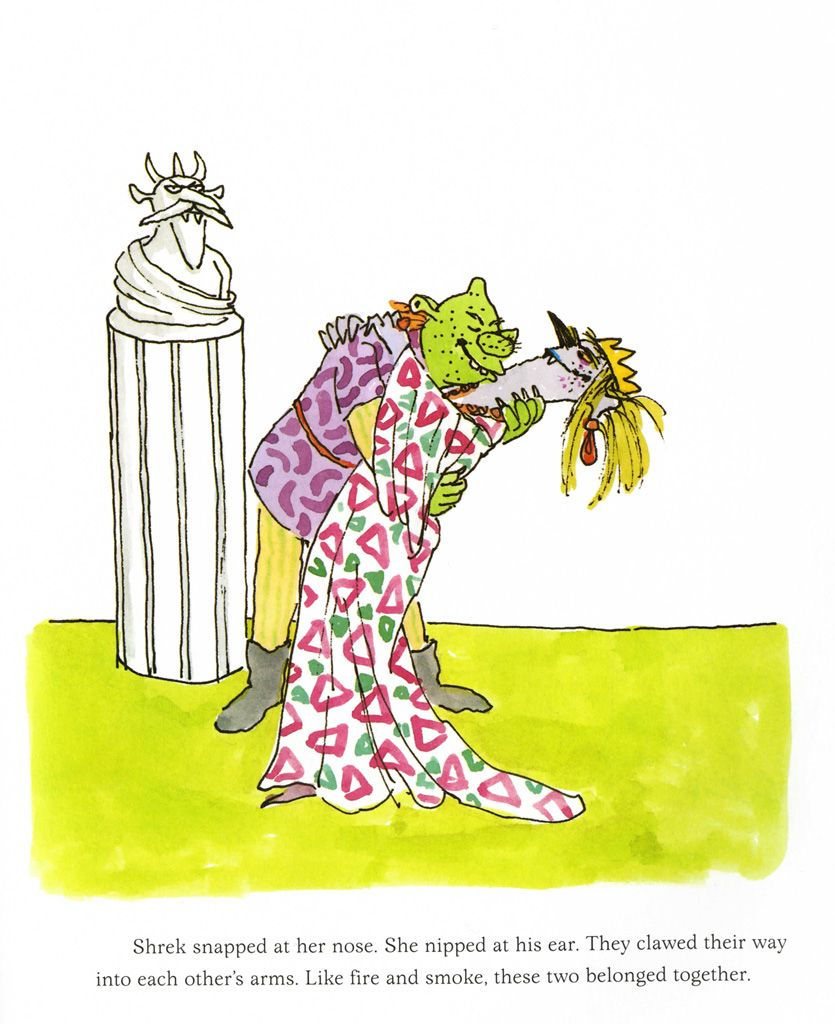
From Shrek

From Shrek

From Sylvester and the Magic Pebble

From Tiffky Doofky

Untitled

From Rotten Planet
I will end here, but of course there are many, many more.
Plus, an honorary mention of Mouse Tales by Arnold Lobel, who wrote Frog and Toad.
